Showing posts with label Education. Show all posts

Saturday, 7 September 2013

The quiet child

Just recently I attended a seminar about personality type. It was a fascinating and thought-provoking course and made me think about how much in education is geared towards the extrovert.  Gone are the days where children are expected to sit silently, taking instruction from their teacher, working on their own from a textbook or copying from the blackboard.  Today's classroom is a noisy place, even reading can no longer be relied upon as a quiet endeavour.  If you were to take a tour around a primary school now you would see paired reading, group reading, interactive reading activities around the smartboard and, of course, the dreaded reading aloud.  I'm not saying that I'd like to go back to a time where children were terrified into silent obedience but I do feel that for the introverted child the world of school must be a place with no refuge or break from extroverted expectation; a world therefore of stress and anxiety.  Children are sat facing each other in groups, teachers are trained to question, challenge, instigate, all at a pace.  There is little time for quiet reflection instead children must put themselves forward, think on their feet, adapt, contribute, discuss, debate, all as part of a team where the more serious individual is passed over in favour of the entertaining one. 
(image credit: thepowerofintroverts.com)
The introverted child is often labelled with a whole range of negative adjectives: awkward, lacking social skills, unassertive, passive, aloof, not a team player, timid...I could go on.  There is a basic misunderstanding about the nature of the introvert: that they are shy and anti-social when in fact it is simply a difference in energy.  An introvert can be sociable; they can be noisy, they may well enjoy a party, but this cannot be sustained for long. An extrovert gains energy from being around other people; without social interaction they become fatigued, whereas for an introvert this is draining and they need time alone to recharge.  They have a rich inner reserve that they need time to draw from and then top up again.  In a perfect world there would be a balance between types but true introverted personalities are outnumbered; for every introvert there are three extroverts. 

With this in mind it's not surprising that the introverted child is so often overlooked in the classroom with few opportunities to show their strengths. Susan Cain, the author of the bestselling book 'Quiet: The Power of Introverts in a World That Can't Stop Talking' makes the assertion that introversion is 'not something to be cured'.  If you've not come across her book then I'd recommend it. It's a startling read and does much to de-bug those personality myths that have become so ingrained in our extroverted culture. She champions the introvert and I think her Quiet Manifesto should be enshrined in every teacher's classroom and for that matter every workplace. If you find yourself nodding in quiet agreement then it's probably because you have a little introvert in your family or recognise this preference in yourself. Although introvert-extrovert is a spectrum, I can say with some certainty that I have two children who are at opposite ends! Consequently parenting is a fine balance especially when you find yourself quite the opposite from your partner as well! Here are my key strategies for nurturing your quiet child:

  • Use positive adjectives: let your child know that it's more than alright to be 'thoughtful', 'reserved', 'quiet', 'focused', 'inquiring', 'investigative', 'a good listener'. Share their strengths with teachers, let them know that they like to have time to think before speaking, that they need to observe before doing, evaluate what they've read before responding, express their thoughts in a variety of ways other than just verbally, 
  • Provide a sheltered place:  in your home a cosy nook that a child can retire to - a little space to call their own. At social events find acceptable ways to take a break from too much company and filter out noise i.e. earphones for music, a book under the table, a short walk or task that gives time out for five minutes.
  • Nurture the difference: reject over-zealous efforts from others to 'bring them out of their shell', to join more groups and societies, make more friends. Instead encourage friendships with one or two like-minded children or those happy enough to play alongside rather than always with and who are not offended when your child wants to spend time alone. 

(image credit: psychologytoday.com)

Linking up this post with The Monday Club at Hello Wall.  Do visit and check out lots of lovely blogs.

themondayclub

Saturday, 24 August 2013

And so it begins...

One of the weird things about living in Scotland (and there are a few) is that we start back at school for the Autumn term in the middle of August. To me, September is firmly established in my mind as the start of the new academic year and going back when the rest of the UK, and most of Europe, are still on holiday seems all wrong like an early whole school detention or something. To make it worse we don't get the bank holiday this weekend either. My family, and friends who live in England, are confused by the differences too, seeming amazed every year when we break up at the end of June and rather resentful, believing that we have an incredible 9 weeks off!


And so it is that Tuesday 20th August the school year began and the long languid days of summer came to an abrupt end in The Little House. This year I have been determined to get off to a calm start, and be organised, avoiding the school-term-induced mayhem that usually takes over our lives at this time of year. I bought new school shoes for S at the end of last term smugly believing that I would avoid the crowds and the whole 'take a ticket' experience of Clarks. Of course, in the last week of the holidays, perhaps nourished by lots of sunshine and ice-cream, her feet have grown a whole size!

S ended up with these rather dapper
 brogues from Next instead

I made sure uniform was ready (believing it to be clean and hanging in the wardrobe) only to find mysterious pink stains on one skirt and one new school sweatshirt with what appeared to be a  half eaten sleeve (Could it be giant moths?  Did the school hamster escape and fancied a nibble?) Turns out that S had hung the skirt up dirty in the first place (pink icing apparently) rather than put in the laundry (at least she hung it up I suppose) and the sweatshirt didn't even belong to her. She'd brought home someone else's, from the name tag - a boy's of course!

We went to one of my favourite places - Paperchase,  supposedly to stock up on school supplies.  We spent nearly an hour browsing and indulging in stationery addiction and bought a selection of items that can neither be classed as essential or necessary.  Then it was time for one of my favourite family traditions - the last ice cream of the holidays. 

We sat outside in the afternoon sunshine and savoured them, discussing the best bits of the Summer and sharing school-related hopes and worries (it's an important exam year for H and the last year in Primary for S). Although I was dreading the 6am alarm the next day, I felt settled and, well, almost ready...


Tuesday, 13 August 2013

Make me a German


The BBC's current obsession with all things Teutonic has spawned a most peculiar mix of programmes over the last few weeks. Don't know if you managed to catch the oddly titled 'Make Me a German' but I found it very interesting viewing. The premise was that a British couple, Justin and Bee Rowlatt, went to live in Germany and lived as the average German family (which meant, in fact, that two of the family's four children had to stay in the UK with grandparents as German families are, on average, smaller than ours). They were renamed with the most common surname, Muller, lived in a typically German (rented) apartment and Justin was given a job in a traditional industry - Faber Castell. The programmers even went so far as to provide a checklist of averages for the family to conform to - for example, what time they should get up, what they should eat and how much housework to do.  This was 6.23am, a kilogram of pork each week and an unbelievable 4 hours each day, in case you were wondering.


The programme relied on stereotypes which was bit disappointing but it did leave me pondering on the reasons behind Germany's economic prowess and the differences in attitudes to work, education and family life. 

I admired the dedication and loyalty of the workers in the pencil factory many of whom had been taken on on a proper apprenticeship scheme. Apprenticeships in Germany last three years and include training on all aspects of the industry resulting in a multi-skilled, highly-employable worker. Germany has the lowest youth unemployment rate in Europe and 'a job for life' is not an outdated concept.  Wouldn't it be brilliant if we offered such schemes to our youngsters and valued practical and technical skills rather than try to push everyone through the same academic hoops. I suppose though, that that's a possibility as Germany is such a manufacturing powerhouse and there was a downside: the programme highlighted the fact that many German workers have sacrificed pay rises for job security.

In the Faber-Castell factory
The programme suggested that working hours were less for the average German but productivity was much higher.  How can this be? Yes, you've guessed it, it's all about punctuality, focus and discipline.  The factory had a Victorian school-like environment - no chatting, no slacking and definitely no checking your phone! Whilst conditions were good, healthcare excellent and the heavily-subsidised canteen much appreciated, I wondered at the nature of the average British worker versus the German.  Can we be as disciplined or are we inherently anarchic, appearing to tow the line but actually working to achieve our own ends?

I liked the emphasis on community shown in the programme with the tone-deaf Justin off to a very jolly singing club one evening after work, one of 100 such groups in the area.  If there was such a club here to join I suspect that the average age would be 85! By comparison, Justin's wife, Bee, felt she had drawn the short straw when it came to fun in their German experiment. The four hours of housework a day seemed excessive and made me reassess just how much housework I do ('Not enough,' my mother would say and she'd probably be right).  On a week day in term time I'm away from the house for around 10 hours which doesn't leave a lot of time for chores and then I want to spend time with the girls which isn't compatible with hoovering! Statistics show that on average in the UK a married woman will do 7 hours housework a week.  I think that's probably about my average too though looking at the state of the house you wouldn't think so! Considering the adherence to 'quiet laws' in Germany (basically no noise between 1-3 and in the evenings), and the observance of Sundays as a day of rest (and quiet again), it must be pretty difficult fitting all that housework in.  
(image credit: telegraph.co.uk)
Motherhood seems to have far greater a status in Germany and valued, as it should be, as an important job. Two thirds of mothers with young children stay at home in Germany compared with just a third in the UK. Childhood is unrushed and protected. Formal education starts at 6 years, there are no SATs or ridiculous Gove notions on learning outcomes for the very youngest members of society. Instead the emphasis is on play for its own sake and learning through discovery.  The pre-school set in a forest was as Bee described 'kid heaven' and when I think that many families spend in access of £600 a month on nursery fees in the UK they would be more than a little jealous of the 25 euros a week or around £80 a month cost in Germany. Combine the quality of the childhood experience with the very attractive tax breaks and it would be easy to assume that life is better for young families in Germany. But, there was another side to this wholesome image in that despite reasonable childcare costs, it is not easy to maintain a career as a mother in Germany. One of the mothers in the programme explained that the school day finishes at 11am three days a week and the attitude prevails that by working you are neglecting your children hence the German expression 'raven mother'. I wonder what the German attitude is towards stay-at-home dads?! To be ideal it would be nice to have a real choice about being a working parent, to be able to afford to stay at home if that's what you dearly want or choose to work, confident in affordable high quality childcare.


Well, this has been a much longer post than I intended and you can see it's got me thinking. If you've managed to read this far I'd love to know your thoughts too.  If you missed the programme I think you can still watch it here. For now though - Auf Wiedersehen!


Linking up this post, rather belatedly, with Sarah at Hello Wall

Saturday, 22 June 2013

The Dyslexic Household

Have you heard the one about the dyslexic devil worshiper?
He sold his soul to Santa.
What about the dyslexic lawyer?
He studied all year for the bra exam.
And you have to have heard the one about the dyslexic, agnostic insomniac?
He lay awake all night, wondering if there was a dog!

To those of you who didn't find any of those jokes remotely funny I apologise. Not very PC of me, I know, but some days I have to find something about dyslexia to laugh about or give in to despair.  My excuse for such poor humour is that my life very much revolves around dyslexia as not only do I work in learning support, helping dyslexic pupils, but when I return home, my job continues as wife to a dyslexic husband and mum to two dyslexic daughters. We are very much a dyslexic household and I am constantly reminded of the many ways that dyslexia impacts on so many aspects of everyday life; it is not restricted to the classroom.

If you've had any experience of dyslexia then you will know that it is not a difficulty that simply involves swapping letters around, the punchline in all these jokes, but instead a complex condition affecting more than just reading and spelling - there are the concentration issues, short term memory problems, disorganisation, word finding difficulties...to name just a few.

(image credit: motorvatetherapies.co.uk)

When I first met The Wonderful Man and we were dating, his dyslexia was responsible for quite a few comic misunderstandings and confusions.  I offered to stop and get some shopping for him and he gave me a list.  I spent a considerable amount of time trying to decipher his spelling of some items.  I worked most out, for example, I could see that 'seriel' was 'cereal' but there was one word that seemed entirely random. I gave up and went home to be told that it was 'quiche'. I can't remember the exact misspelling but I remember it started 'kea' !! Another time  I went to meet up with him after work in a pub called 'The Windsor Castle' and searched for some time before discovering that he was already on his second pint in 'The Walmer Castle'.

The problem with dyslexia and spelling is that very often someone with dyslexia has weak phonological skills - their brain just can't hear the subtle differences in sounds.  The sound made by a 't' and a 'd' for example can sound pretty much the same, making the process of 'sounding out' a word pretty hopeless. Add to that the problem of the same letter pattern having completely different sounds such as 'cough' and 'though' and you can imagine the problems faced by the dyslexic.

Sometimes just to make things more difficult it can be difficult to remember the visual shape of letters as well; you might know you want to write a 'd' but end up putting 'b' instead even though you know perfectly well the difference in sounds. English has lots of similar looking letters 'p', 'q' 'i' and 'j' just to name a few. The strategy of 'does it look right' isn't helpful either because a dyslexic might write many different spellings of the same word and they all look right!

(image credit: bbc.co.uk)
When H started nursery it was already apparent that she was probably dyslexic too. Dyslexia is on both sides of the family and so, although I'm not sure of the statistics, I knew that our genes combined would seem to double the chances. H was such a funny little thing - incredibly creative in her way of getting around her difficulties. She often confused words and names for things once offering to post a letter in the 'post lamp'!  Her poems were full of half rhymes and when she was seven, having got frustrated at trying to write a very imaginative story, she drew instead a fantastic and lengthy storyboard with captions and little speech bubbles. Her teacher was amazed at the detail and left it up on her wall for many years after H had left her classroom. S began to use the computer very early on becoming very computer literate.  Her report from school states that in Primary 4, aged 8, she could have 'very easily taught the ICT lessons herself'.

Certainly life in the dyslexic household has its frustrations and sometimes I grow weary of being home teacher and walking dictionary but I have also come to appreciate how pretty amazing the human brain is and that difficulties don't have to be difficulties at all - just differences. My family is a collective of very quirky individuals with their own strengths and gifts and sometimes my non-dyslexic self feels very ordinary in comparison.


I'm linking up with the lovely Sarah at Hello Wall with this post at The Monday Club:

themondayclub

Saturday, 8 June 2013

Back again

Well, after an unintended absence of two weeks from blogland I'm back. Not that I think many would have noticed my lack of contributions but I've missed sharing and tuning in to my online circle of friends.  The last couple of weeks have been particularly manic in the Little House and each time I've tried to sit down and write, my mind (significantly smaller than most) has been too full to produce any coherent post - only the written equivalent of gibberish! Finally, feeling refreshed on this super sunny Saturday morning, I thought I would try and identify what exactly has caused so much 'to do' - so here are my Top 3 Stresses which I suspect are shared by many but probably managed a whole lot better:
(image credit: badmommy.com)
1. The Special Event
This last week has been our local primary school's centenary celebrations and like many schools they decided to turn this into a special event and a chance for some educational enrichment and so we had... 'Edwardian Week'.  A whole week, I ask you!  A whole week where S was expected to dress up as an Edwardian and take part in thrilling activities such as... finger knitting. It's the dressing up bit that caused the most stress.  S was determined to wear this hideous shiny 100% nylon dress from the dressing up box but I couldn't imagine it would be very practical and not at all Edwardian - more Bordoirean!

Quick! Wave your red petticoats!
 I did some research but whatever search terms I put into Google I was always presented with pictures of Edith Nesbit's 'The Railway Children'; it would seem that as well as risking life and limb playing on railway lines, Edwardian children wore peculiar sailor outfits and lots of smocks. I hasten to add that I possess no sewing skills whatsoever and do not live near any family members who might be called upon to help. Finally in desperation with a late night dash to Asda, I settled on a vaguely vintage-style dress.  Once paired with ribbon and S with her hair in plaits the look was not exactly right but it was getting there.

2. Missing Husband
Good listener - Dorothy
I could mean 'missing' as both an adjective and verb here.  It wasn't that I didn't know L's whereabouts - he was in deepest darkest Reading - and he was only gone a few days, but the challenge of managing house, children, animals and getting to work on time proved doubly exhausting and I take my hat off to single parents everywhere! L usually works from home and so his absence meant trying to find childcare at either end of the day and then there's the dog's bladder to worry about. Depositing youngest child before 7am at a friend's house is truly a test of friendship if ever there was one. The house was decidedly tidier and quieter without him but my motivation to cook something healthy lasted all but a day and on the second night I resorted to takeaway fish and chips.
On the third evening, already dressed for bed, I realised that I hadn't shut up the henhouse and worrying about foxes, negotiated my way across the mossy chicken poo lawn in my slippers to put them to bed.  It was still light and missing an adult to moan to I shared my woes aloud with Dorothy, our speckledy hen, which would have been fine if a late night dog walker hadn't been going past to hear me! 

3. The Embarrassing Incident
I was quite pleased to have almost got to the end of a trying week when it happened - the embarrassing incident that creeps up on you just when you least expect it. Being a teacher there are many opportunities to embarrass yourself in front of a whole class of teenagers and this week one such opportunity arose. There I was at the front enthusiastically reading 'Skellig' (great book by the way) entertaining the restless with a suitably Skelligy voice.  But I grew weary of standing and I perched on the edge of a small wooden cabinet.  The weight of my significant posterior was all too much and the top shelf gave way with explosive force.  Papers, pens, books and I slid to the floor in embarrassed heap.  There was a hushed silence and then much hilarity ensued.  It's not every day that your heavyweight teacher breaks the furniture! In the end I had to laugh too and I was pleasantly surprised by their concern, even though I know they will dine out on retelling that story for weeks - thank god we have a strict 'no mobile phones' policy or I'd be on the week's picks on youtube! Now where did I put the Weight Watchers recipe book...! 

Some might say that none of these are particularly stressful events at all and when compared to the endless stories on the news of tragedy and loss they are indeed trivial. Still, stress is relative and the only way to combat is to either change the situation or if you can't do that then change your reaction to it - humour helps, I think.  What are your top stresses and what do you do to manage them?  

S with her finger knitting (note the Edwardian colour of the wool!) 

Monday, 15 April 2013

Absurd surds and other maths madness

H wanders into the kitchen, maths revision homework in hand, "Mum, what's an irrational number?" she whines in a pleading voice as though I really might have the faintest idea of an answer. The words go in but are then instantly rejected by my right-sided brain.

"Unreasonable numbers that get upset easily," I venture unhelpfully.  She rolls her eyes, sighs deeply and then states the depressing truth:
"You really are of no use at all when it comes to maths," she complains.

To some extent she's right. Now she's 15 years old and building up to national exams I am of little help.  The problem is she's left me behind.  I can do fractions, decimals, even simultaneous equations. Averages do not faze me at all, percentages - no problem, and I know that Pi has nothing to do with pastry or a film involving a boat and a tiger. But this is a foundation level understanding only and H has moved on to inscrutable topics involving tangents and indices.  I cannot bring myself to look at the chapter in her maths textbook entitled 'Algebraic Expressions and Formulae" without feeling quite dizzy. 


In my role as a learning support teacher I often have to think of creative ways to explain mathematical concepts. In the junior school, for instance, there is great job satisfaction to be had when after marching around the edge of the playground a pupil finally understands perimeter or when the mystery of fractions are revealed by cutting up cakes. Even at secondary level I find the idea of a lift and floors below ground level helpful for the concept of negative numbers  (I know, I know, the proper term is 'integers' but what help is that!)  and I have always associated the hypotenuse with a hippopotamus - being the biggest side (ok, ok, the longest side - but you get the idea) *Pythagoras turns over in his grave several times*


My brain is all about words and pictures and I do not make logical connections. When H explains that she is asking about irrational numbers because it is to do with something called 'surds' I am none the wiser. This is an entirely new piece of vocabulary to me and I can't help but think about Serbs instead and have visions of human-sized numbers dressed  up in Serbian national costume running around the Balkans being irrational. I turn to the dreaded textbook which informs me that 'All real numbers are either rational or irrational'.  Are there unreal numbers then?!  I read on: 'Roots of rational numbers which cannot be expressed as rational numbers are called surds.'   Arrhh, all is clear...as mud. Seriously, what on earth does that sentence mean? They may as well have put 'the answer's a lemon' for all the explanation it provides.

I turn to the fountain of all knowledge - Google -  and come across a video on youtube made by some geeky guy in his bedroom. I didn't know that 'maths porn' like this existed and it proves enlightening. He explains in his nasally voice (and helpfully demonstrates on his scientific calculator) that surds are really just 'nasty square roots'.  It doesn't matter that I don't share his opinion that there are nice square roots, I have made progress and H and I solve the first three questions together.  The white wine seems dangerously low though at the end of it and I think it's time we employed the services of a professional, and sober, tutor rather than rely on social media, alcoholic sustenance and my maths-confuddled brain. 

Saturday, 12 January 2013

Back to uniformity

Going back to school this week was quite a shock.  We have had two weeks of no schedule and if it hadn't been for visitors I suspect there wouldn't have been even one day where we were properly dressed. When I put my work shoes on on Monday morning I actually thought there was something wrong with my ankles until I realised that I was simply unused to the sensation of wearing heels and any sort of supportive footwear; I have been wearing bed socks with my wellies,  bouncy fake Uggs and furry slipper socks. There were collective sighs all round as we dragged out school bags (although I suspect that L's sigh was one of relief as he gets to enjoy peace and quiet again). Even the brand new fully-stocked pencil cases, supplied by Santa & Co, couldn't lift the 'back to school' gloom.

H & S in younger days
When the alarm went off at 6am on Monday it honestly felt like I was coming round from a general anaesthetic.  I immediately consulted the calendar and worked out though that there were exactly five weeks of school-led structure left and then we get another mid-term break so there really is very little to moan about.  It is perhaps one of the only monetary benefits of being a teacher - all those paid weeks of holidays.

As a teenager I was desperate to leave school.  One of the main reasons for hating it so much was the capital A-line grey skirts and maroon striped ties of the uniform. I've never been one for conformity so it seems quite ironic to me that I have ended up back at school all this time later with all the rules and regulations that extend to teaching staff too.  At formal events we are even required to wear academic gowns though I have to say they are very good for smuggling whole bags of illicit sweets into assembly or for concealing a hot water bottle to make sitting in the freezing chapel more bearable.

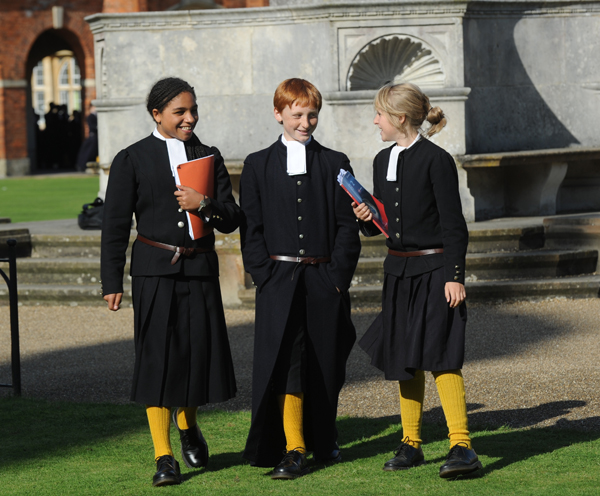
The UK has a long history of school uniform dating right back to Henry VIII.  Then the long blue trenchcoat-style jackets had some practical and cost saving benefits, though I'm sure they must have been heavy and most certainly humbling to wear.  The supporters of uniforms have a long list of purported benefits - suggesting that they somehow instill discipline and even improve results. Of course, the most common given reason for uniform is that it is a great social leveller, but there are so many other just as obvious ways to display your wealth or lack of it; a quick glance at mobile phones, shoes and school bags for example.
Pupils at Christ's Hospital School in West Sussex
The school I teach in has a distinctive uniform that I have to concede the children seem proud to wear.  They still have their complaints though, not least about the wide unfashionable trousers and stiff wool blazers that smell like wet dog the minute they become the slightest bit wet - which is all the time in Scotland. Older girls will attempt to shorten their kilts by rolling over the waistband but this results in a deeply unflattering pleated tutu - a bit like a tartan version of a Greek dancing skirt.  They're lucky in having a fairly kind ensemble. They could have ended up with a Tudor-era uniform complete with Malvolio-inspired yellow socks or a ridiculous ribboned straw hat.

"Am I bovvered"
You can probably tell, I'm not really an advocate of uniforms; I find them restrictive, impractical and, well, a bit bizarre. Ties especially I think are nasty germ-ridden things and girls in ties? - what's that about!  I was very surprised when S really liked her tie when she started school in Yorkshire, but then I realised that this was only because she found it very useful to use as reins when playing horsey games with her friends in the playground! The boys at her school preferred to tie them around their heads Rambo-mode. Older teenagers would attempt to tie the biggest knot possible, not a Windsor or a half-Windsor but a full on Windsor Castle knot which they would then leave askew in the style of  Lauren Cooper. My colleagues try to persuade me to the merits of uniformity saying, 'It will prepare them for the real world of business'.  Put that off for as long as possible I think - I have no desire to see that my children are 'ready for work'.  No! Back to weekend rebellion say I - bring out the fuzzy leopard boots, the hoodies and the onesies and let's turn our backs on the real world, for 48 hours at least.

This post is linking up with 'Oldies but Goodies' blog hop hosted by Suzanne at 3 Children and It
3ChildrenandIt