Friday, 25 July 2014

Word of the Week: Haar

A haar (pronounced like far ) is a useful little Scots word for the peculiar sea mist that comes to visit every so often on the east coast. This week it has made quite a few unwelcome appearances. While the rest of the country bathes in brilliant sunshine the haar will suddenly roll in across the North Sea and envelop the land around the coast in an eerie hazy blanket. 

Looking down at the haar rolling in
The word itself, as I understand it, derives from a German and Dutch term originally meaning a cold easterly wind but in this part of the world it specifically refers to the fog that rises off the sea. The 'cold' reference is appropriate because the haar is a most unseasonal guest. Its clutches are damp and icy and it's liable to cause those who get caught in its wintery grasp to scuttle home to find blankets and turn on the central heating, forgetting that we're in the midst of summer!

You never know when the haar will appear or how long it will stay. This week it arrived quite suddenly and ruined a bright sunny morning. It burned off by midday but then later crept slowly around the edges of the garden, extinguishing the afternoon's warmth with its chilly breath. I can understand how some locals are superstitious about the haar as it has an almost supernatural quality in the way it shifts and shrouds everything in grey.  If it was a character then I imagine the haar as a gloomy figure, perhaps like the Groke in the Moomin books.

The Groke (image credit: kindertrauma.com)

Driving along the top of the coast road yesterday I came upon the most spectacular haar which quite literally rose up around the car obscuring all road markings. The sun was desperately trying to get through but the murky curtain was determined to keep it hidden. Once high enough and out of the mist, I pulled the car over and tried to capture the spectacular sight with my phone's camera. Normally, this is a good viewpoint; you can see right across the bay and out towards Dunbar and the Torness power station and on a clear day beyond to North Berwick Law and Bass Rock. Yesterday, however, the haar had completely covered the sea and the coastline with billowing waves of cloud. It looked a little scary like some science fiction movie but also rather magical and I found myself mesmerised. 

The usual coastline view

Yesterday's view: you can just see the cement works chimney peeking out

The Reading Residence

Saturday, 31 May 2014

Word of the Week

So why have I chosen the name of a random body part for my word of the week? Well, basically because for the last few months I have come to hate my elbow and all it might represent! 

In fact, elbow is a fairly stupid word to begin with - 'el' part from old English for length of forearm and 'bow' from West Germanic origins meaning bend or arch. That seems sensible, right, but go back further and other older translations show 'el' and 'bow' as being the same thing so elbow in this sense means 'bend bend' - ridiculous! And ridiculous it has been trying to do anything involving my right elbow at the moment - it doesn't bend well even once let alone 'bend bend'. 

I've been plagued with what I've assumed is 'tennis elbow' for months. It seems an unlikely ailment for someone who never plays tennis but it's a lot easier to say than its proper medical term 'lateral epicondylitis'. I found that I couldn't lift a full kettle or brush my hair with my right arm (there are those who would say that my hair doesn't look any different unbrushed anyway), I couldn't turn a door handle or open a jar. These were all minor inconveniences as I could generally use my left arm instead. But then, I discovered that I couldn't fill the car up with petrol and when I tried to do so with my left hand, I dribbled petrol on the ground in what the garage called 'a spillage' and caused the attendant much moaning and muttering. I  probably would have continued to put up with it but the aches and pains seemed to migrate and my other elbow came out in sympathy for a while. Then a few days later my wrist became painful and then the joint at the bottom of my thumb. It was like a peculiar bodily game of 'pass the pain parcel'. 

Fed up, I took myself off to the doctor. She's quite a character my doctor. A fervent energetic lady who likes to sit in her doctor's swivel chair with her legs curled up beneath her like a cat, her shoes discarded beneath her untidy desk. In a voice much like Victoria Wood's she told me that I was right to come in and she wanted to do some 'fancy' blood tests. Blood tests? For a sore elbow? Ok, I thought, whatever,  and smiled indulgently at her.

The phlebotomist looked thoroughly delighted to see me. There were at least 8 phials awaiting my blood - more than enough to keep a vampire going for at least a month. She told me in hushed tones that these 'fancy' tests were expensive and so I did not complain as she repeatedly stabbed me, searching in vain, well, for a vein!

It turns out that I am something called 'seropositive' for rheumatoid factor and antibodies. Despite believing myself to be the very best 'Google doctor' I still don't really understand the rather complicated information about rheumatoid arthritis but I do understand that this isn't a confirmed diagnosis as apparently it is possible to have a positive result and not have it. Not so 'fancy' a test to be really useful then! So I will have to be patient and wait to see a rheumatologist for his opinion. I am thankful that my symptoms at this point are relatively mild and manageable and I'm still hopeful that rheumatology will laugh at such a suggestion and dismiss the idea altogether. I'm still working on my relationship with my elbow. 


I'm joining in with The Reading Residence and The Word of the Week Linky.
The Reading Residence

Sunday, 18 May 2014

A Fishy Tale

Well, it seems an awfully long time since I posted anything on this blog. The reason?...Just life, I think, taking over and filling up all my time. The teen has needed my help persuasion to revise and get ready for her exams; I was faced with an inordinate amount of paperwork to do and this nagged at my conscience each time I sat down and considered writing for pleasure rather than form filling; also I have been suffering with a RSI type elbow pain that has had me wincing every time I go near the keyboard. Now the exams are over for H (they're terrifically early in Scotland), some of the paperwork is done and I can type, slowly, with my left hand!

Keep reading - all will be revealed 
I know what you're thinking - what has any of this got to do with fish? Well bear with me and all will be revealed...eventually.

Our village hall is a rather utilitarian building with little going for it if you were judging purely on aesthetics. But we have a wily committee full of enterprising types who have done much to improve its appeal and increase its use. There's a community cafe, plant sales, a second hand book store, musical performances and a weekly mindfulness session to name just a few of the many events that take place regularly. So it came as no surprise to hear that there was to be a play in the hall and I duly bought tickets. The last time I went to see a 'local' production I had to bite my lip to stifle the giggles as various octogenarians shuffled about in dubious costumes and forgot their lines, and so I was not expecting much. I was to be proved very wrong in my assumptions.


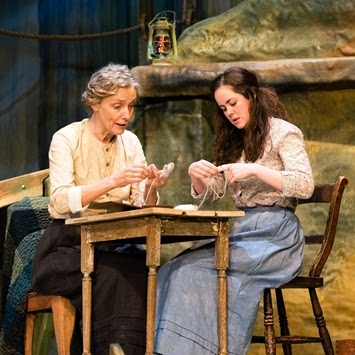
'Get Up and Tie Your Fingers' by Ann Coburn is set against the worst fishing disaster in the UK's history. On the 14th October 1881,  20 boats and 189 men were lost in a storm (129 of them from the small community of Eyemouth, near Berwick).  Just up the coast from there, our tiny harbour, Cove, was hit the worst proportionately, losing four of its five boats and 11 of its 21 fishermen. Many of the family-run boats tried desperately to get back into the harbour but were swept past the harbour mouth and onto the rocks in the bay. Women and children were close enough to watch their menfolk drown but had no way of reaching them. You can understand why that terrible day is still referred to as 'Black Friday'. Long-time locals, some of whom are direct descendants of survivors or those who died, explained that the title relates to the call given to rouse the herring lassies who lived and worked in the local area and travelled with the herring down the east coast of the country.  These plucky women needed to work at terrific speed, sorting, slicing and gutting up to 60 fish in a minute! Those 'silver darlings' were slippery little blighters, and a gutting knife sharp, and so the women would bind their fingers with cotton strips to protect them from cuts and the stinging pickling salt.


The play managed to pull off that difficult feat - of being deeply moving but at the same time uplifting. Through the characters of young Molly, her obsessive and fearful mother Jean, and fun-loving Janet, the play brought to life the courage and resilience of truly remarkable women while exploring the metaphorical ties between mother and daughter. The cast was entirely women supported in turn by an all female choir.  Karen Wimhurst's original score sung a cappella added a haunting quality which was difficult to forget. The inclusion of a nineteenth century children's hymn,  'When Lamps are Lighted in the Town' left hardly a dry eye in the house - a simple and plaintive tribute without being mawkish.
Bronze sculpture at the Cove to commemorate the tragedy
I was so pleased that I went to see it and cannot think of a more fitting setting than within the very community that was so affected by this tragedy. To further the links to the local community, the village school children and crafting groups helped to decorate the hall and knitters across the region were responsible for delightful shoals of knitted herring that will be following the production as it travels down the east coast of England. I really admired the display and managed a chuckle when I wondered what the real herring lassies would have thought of the knitted silver darlings!

Even the corridor outside the toilets was decorated!

A creel of knitted herring


Friday, 25 April 2014

This Moment

Joining in with Soulemama's {this moment} - a Friday ritual. A single photo -  capturing a favourite image from the week. A quiet and mindful moment that I would like to pause and remember.


Sunday, 13 April 2014

The Quirks of Wirksworth

Allsopps Cottage

We've just come back from a a little holiday in Derbyshire. We chose to stay in the market town of Wirksworth mainly because its location made it a good base from which to explore the surrounding area and for us to attend my mother-in-law's 80th birthday celebrations as she lives just north of Derby. Wirksworth is one of the oldest towns in this area of the Peak District and it used to be the centre of the lucrative lead mining industry even as far back as Saxon times. The town today still holds a weekly market as it has done since 1306. As I inspected the modern-day offerings I wondered what those Medieval market stallholders would have had for sale? Perhaps they too might have traded nettle soap, fresh rhubarb and Derbyshire honey! 

We chose to stay in Allsopps Cottage, nothing to do with Kirstie Allsopp but with all the vintage charm just the same.  The cottage itself has been thoughtfully renovated and decorated to retain its character and old-fashioned charm and it included lots of quirky details including aVictorian wash basin and jug and an antique pair of ice skates hanging by the fireplace (it took us all holiday to work out what they were).  

Ted on the washstand

The Edwardian bed in the main bedroom was so high and with such a deep mattress that climbing into it I felt much like The Princess and the Pea. The prince was not so enchanted with its comfort as being 6ft 2" his feet, rather amusingly, stuck out through the end of the wooden frame - a sort of bedtime stocks arrangement!


Close-up of the beautiful tile splashback behind the stove

Cosy sitting room with original fireplace (iceskates hanging left hand side)
To find the cottage you need to go down one of the many narrow alleyways otherwise known as a 'ginnel' if you're a local. The lead merchants built their homes in the dlocally known 'puzzle garden' area and the rush to build, and the lack of any kind of planning, have resulted in a higgledy piggledy jumble of houses and gardens clinging to the steep hillside. If it weren't for the lack of a harbour, it would be easy to believe that you were instead on the cliffside of a Cornish fishing village. Consequently, parking, or indeed driving, in Wirksworth is not for the faint hearted. I don't think I've ever attempted such a steep hill in a car before and I was convinced the handbrake wouldn't hold and the car would roll backwards at speed before we'd had a chance to get our luggage out!  It did not surprise me to learn later that the sharp gradient of Greenhill was in fact where Rolls Royce chose to test their cars' stop and re-start capabilities back in 1912. 


The town today has a bohemian charm and the unique little independent shops, cafes and restaurants have earned it the nickname of 'Quirksworth'.  Though I think it may well be the bizarre customs such as 'well-dressing' (a kind of artistic water worship)  and 'church clipping' (holding hands and dancing around the walls of a church) that have added to this humorous moniker.  I very much enjoyed the quirks of Wirskworth and the friendly nature of its inhabitants but lovely as it was, after a week we were all very happy to return to the familiar and routine delights of home.